The build through Q4
Every year we close the door on Halloween and stare down the final stretch of the year, with BFCM right in the middle of it.
Every operator wants to make the most of this window. Some over-engineer it, most run it like a retailer or ecomm brand. They force an offer and the results show it: more tickets sold, less revenue kept.
We have been running BFCM with operators for a decade now. Here is our playbook.
What is the goal of BFCM for attractions: it answers "why now?"
The hardest question for any attraction is not "why us?" It's "why now?"
Most guests already like the idea of visiting. They just don't have a reason to book today instead of someday. BFCM hands them one. A clear deadline and a real saving turn "we should go sometime" into a ticket in hand.
That's the upside.
The downside? Most attractions don't see repeat guests the same way an ecomm brand or more traditional retailer does. And the reality of BFCM is attractions are competing against a lot of noise. Higher customer acquisition costs, no reliable repeat purchaser revenue to rely on, volume expectations and discount amounts need to be perfectly in line.
The rest of this playbook is about grabbing the opportunity with these factors in balance. Getting more without giving away more than you need to, and knowing how you may pay for it in December.
The discount sweet spot: 15 to 20%
15 to 20% off is the range that gets more people buying without gutting your net revenue. One of our immersive partners learned that the hard way.
In 2024 they ran 25% off. Tickets jumped 27%, but revenue rose just 7%. In 2025 they pulled back to 20%. Tickets rose even more, and the revenue lift more than doubled.
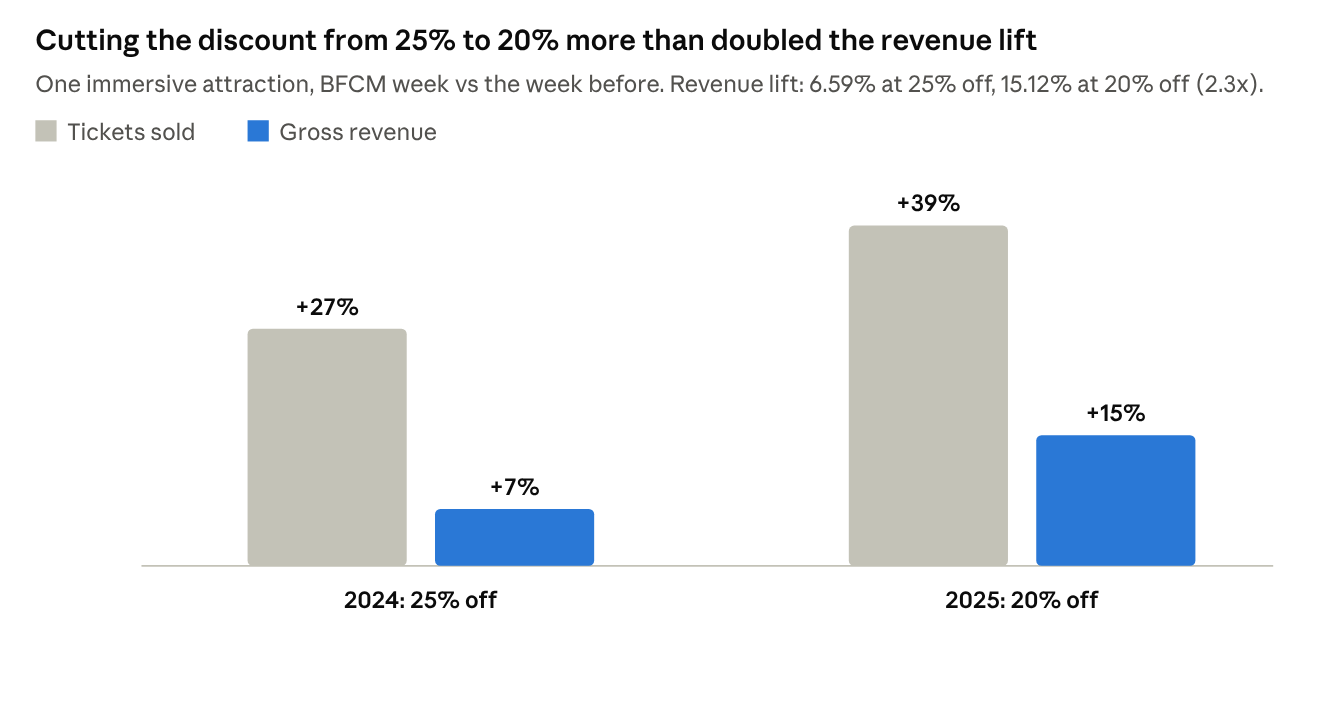
The deeper discount didn't just cost margin. It barely moved the top line. Across seven attractions we tracked that year, the venues running a sale grew the least.
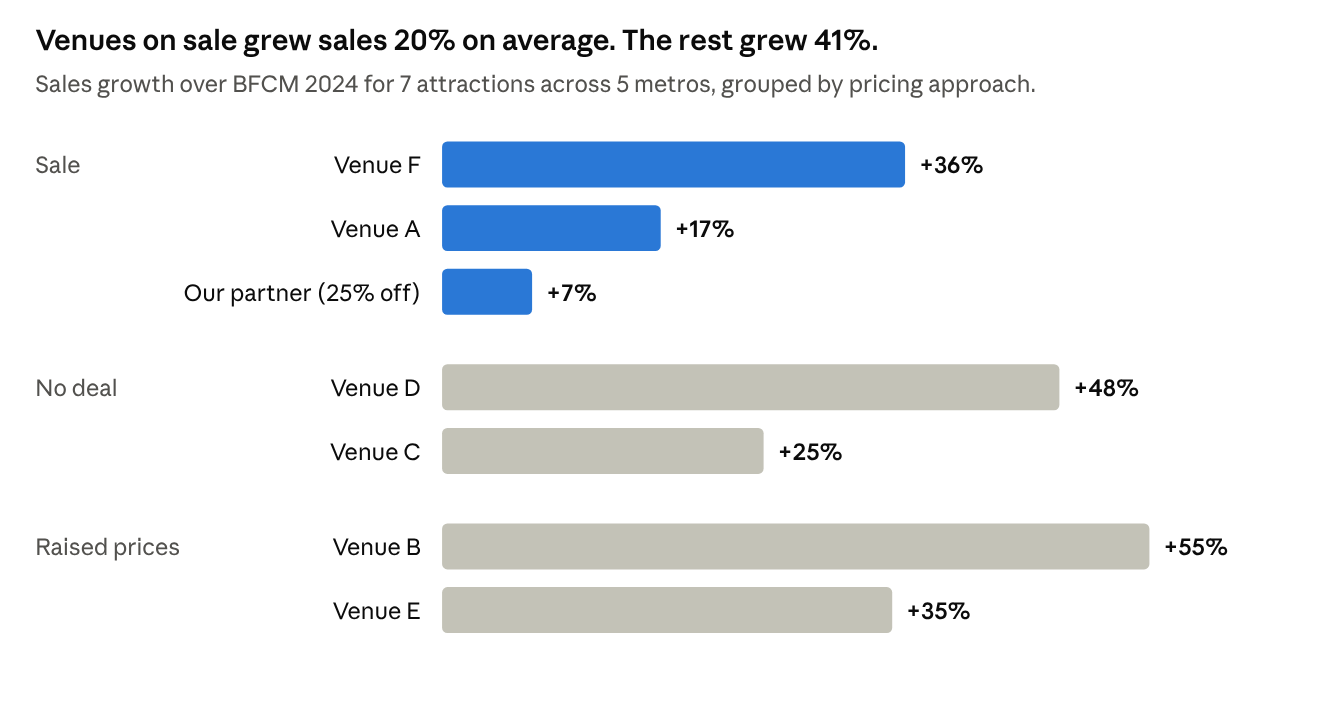
Ecomm brands can go deeper because a discounted first order often turns into years of repeat purchases. Attractions don't get that second, third, and fourth order. The margin you give away on BFCM is mostly gone for good.
The volume vs. revenue math
Every point of discount has to be paid back in extra tickets, and the bill grows faster than the discount. At 20% off you need 25% more tickets just to stand still. At 40% off, the typical deal last year, you need 67% more.
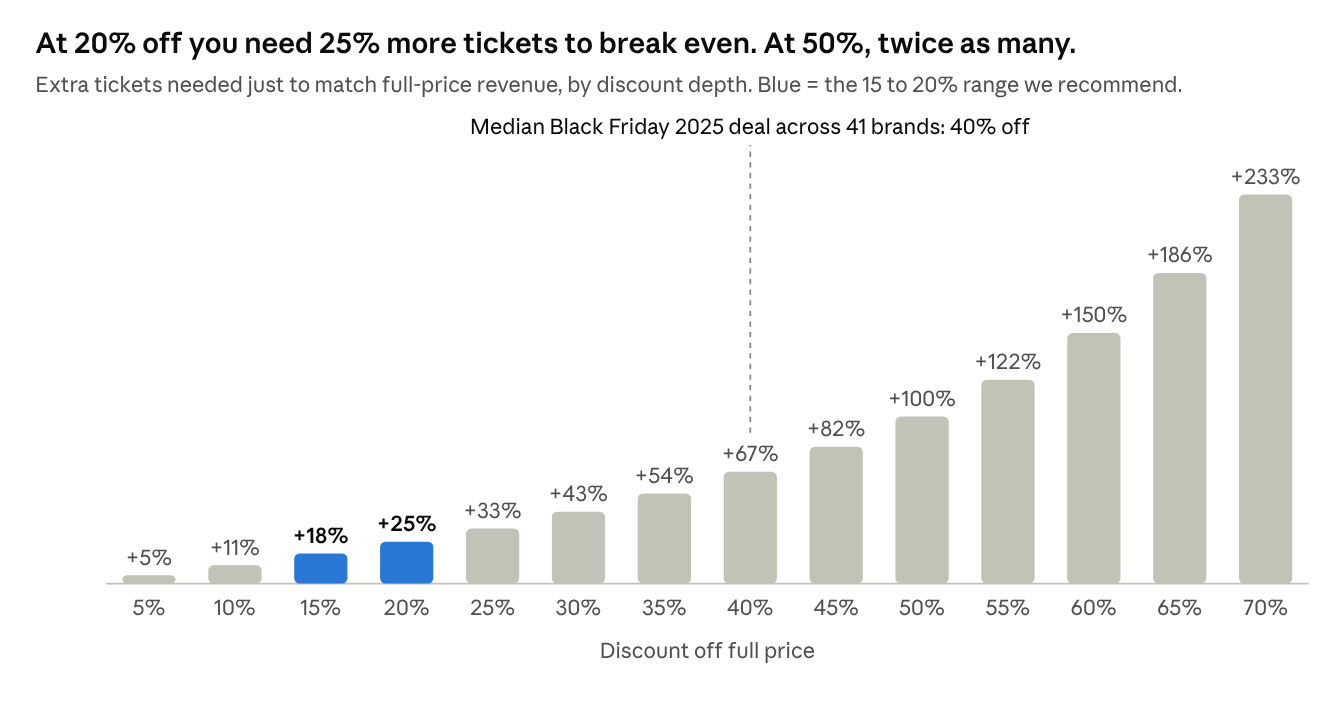
That assumes every ticket sells at the sale price, so a real sale lands somewhere below this line. The shape is what matters: past 20%, each extra point of discount demands more volume than the one before it, from guests who mostly would have visited anyway.
What 100 attraction brands ran in 2025
Most of the industry did the opposite of this playbook. We tracked the Black Friday 2025 offers of 100 major US attraction brands, from theme parks to escape rooms. 47 ran a confirmed promotion. For the 41 we could put a number on, the typical deal was 40% off.
Most attraction brands went deep on Black Friday 2025
Brands on the chart
- Theme parks: Aquatica, Busch Gardens, Dollywood, Great Wolf Lodge, Hersheypark, Holiday World, Kalahari Resorts, LEGOLAND, Peppa Pig Theme Park, SeaWorld, Sesame Place
- Attractions & landmarks: American Dream, Biltmore, Crayola Experience, Edge NYC, Kennedy Space Center Visitor Complex, LEGOLAND Discovery Center, Ripley’s Believe It or Not!, SEA LIFE Aquarium, SUMMIT One Vanderbilt
- Shows: Blue Man Group, Cirque du Soleil
- Trampoline & FEC: Fun Spot America, Sky Zone, Urban Air Adventure Park
- Gaming, VR & escape: Beat The Bomb, Breakout Games, Escapology, Sandbox VR, Zero Latency VR
- Eatertainment: Dave & Buster’s, Five Iron Golf, K1 Speed, Lucky Strike Entertainment, Punch Bowl Social, Puttshack, RPM Raceway, Topgolf
- Immersive: ARTECHOUSE, Meow Wolf, Museum of Illusions
Each dot is one brand’s biggest advertised Black Friday 2025 discount. Gift card bonuses are shown as an equivalent discount ($25 bonus on $100 = 20% off).
The deepest cuts came from theme parks and the big attraction groups, which can lean on passes and in-park spend to earn it back. Eatertainment brands mostly stayed shallow with gift card bonuses, which is how most of the dots inside our range got there. Disney and Universal aren't on the chart: they left Black Friday ticket deals to resellers and still posted their strongest holiday quarters.
Deep didn't mean winning, either. United Parks (SeaWorld, Busch Gardens) started its sale in early November and still ended the year with about 4% fewer passholders than the year before.
What to discount
Put the offer on the ticket that matches how your guests already buy.
- Parks and resorts: season passes. High value, locks in a full year of visits, and gives guests a reason to commit before the new year.
- Immersives, FECs, and non-membership venues: day passes and anytime tickets. Low commitment, easy to gift, and flexible enough to use the same weekend.
Skip the clever bundles nobody asked for. The simplest offer on your most-bought ticket almost always wins.
When guests actually visit
This is the biggest misconception we see. Operators plan BFCM as a holiday play, but it's rare for more than 25% of BFCM tickets to be used over the holidays.
Most guests visit that same weekend or within the next two weeks. At one immersive partner in 2025, about half of discounted tickets were booked for that same weekend or week. Another 30% were dated visits later on, and 20% were anytime tickets.
The last-minute buying habits of the past few years haven't gone anywhere. Plan capacity, staffing, and your on-site experience for the sale weekend and early December, not just the holiday break.
Keep the sale short
The longer the sale, the deeper the trough.
Every sale spikes twice: once at launch, and again at the end when last-chance buyers show up. The dip in between is the trough. One partner's team calls it the hammock: jump, dip, jump. For attractions, trough days can bring in less than a normal day, because every ticket sold nets less after the discount.
You can see the hammock even inside a single week. Early access spiked, the next three days sagged, and Black Friday peaked.
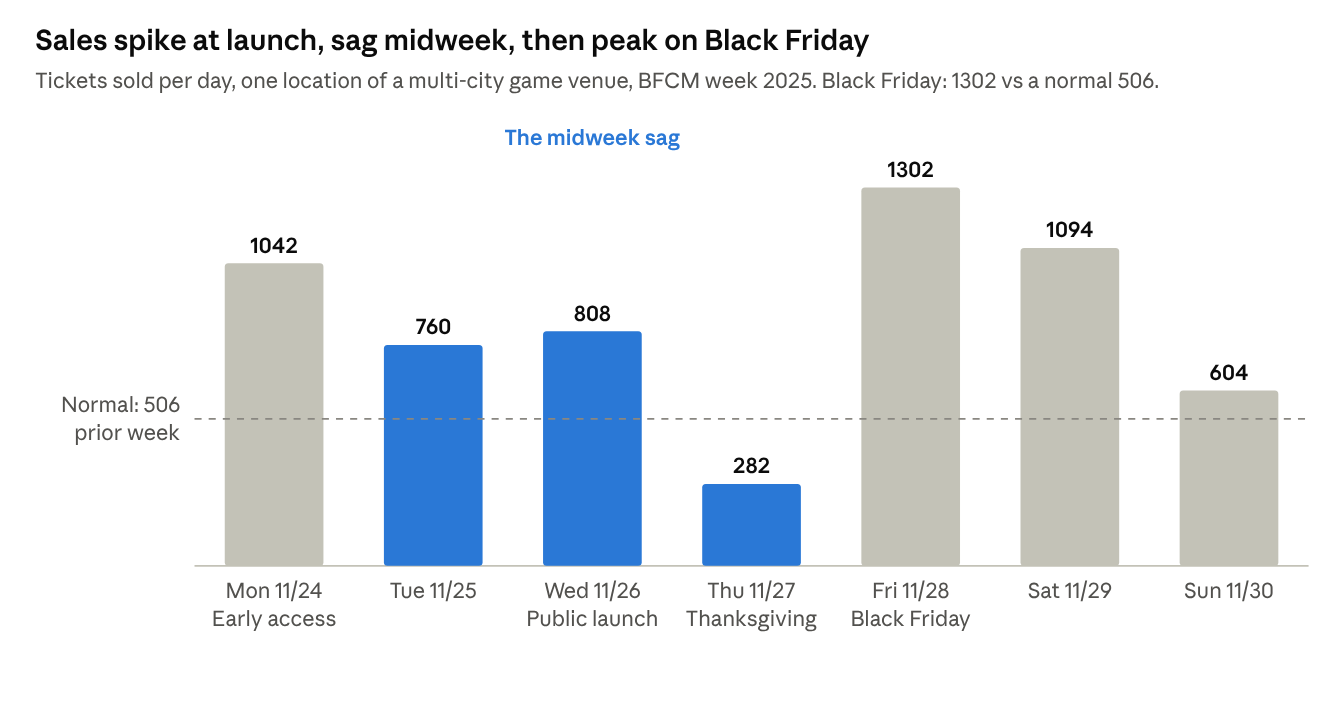
Now stretch that sag across a two-week sale. That's a lot of discounted days earning less than you'd make at full price.
Launch no earlier than the Monday of Thanksgiving week. Monday or Wednesday both work. You skip most of the trough, carry momentum through the whole sale, and make the peaks bigger.
Our secret sauce: 24 to 48 extra hours
Extend the sale 24 to 48 hours past Cyber Monday, through Tuesday or Wednesday.
By Tuesday, every other sale in your guests' inbox is over. Your "last chance" message lands in clear air, with no competition for attention.
It also fixes a calendar problem. Early December is a two-week slump for most attractions. Since most BFCM buyers visit within days, a late push locks in attendance for exactly those weeks, starting with the first slow weekend.
Our multi-city game venue partner has run this play two years running: a "surprise" one-day extension in 2024, then a sale that ran through the Wednesday after Cyber Monday in 2025. Its Black Friday sales were up 50% in dollars and 68% in orders.
The channels that carry BFCM
Every ad channel gets more expensive during BFCM. You're bidding against every retailer on earth for the same feeds. The offer in your creative is what earns that cost back.
- Email and SMS: hit your own list first and hardest. Owned channels cost the same on Black Friday as any other day. Send a teaser, a launch, a midpoint reminder, and a last-chance message.
- Paid social: budget up, and put the deal in the ad. Costs climb across the whole window, but sale creative is what earns them back. Plan to spend more, not less, and don't cap ads that are working.
- Search: protect your brand terms first. Bids get pricey here too. Guests who hear about your sale will search your name, so make sure you show up first, with the offer in the ad.
- Save the extension for owned channels. The extra hours after Cyber Monday work best as an email and SMS story: "You missed it? You've got one more day."
Plan for the hangover
BFCM pulls demand forward. The guests who would have booked in early December already bought, and at a discount. Expect the next two weeks to run below normal.
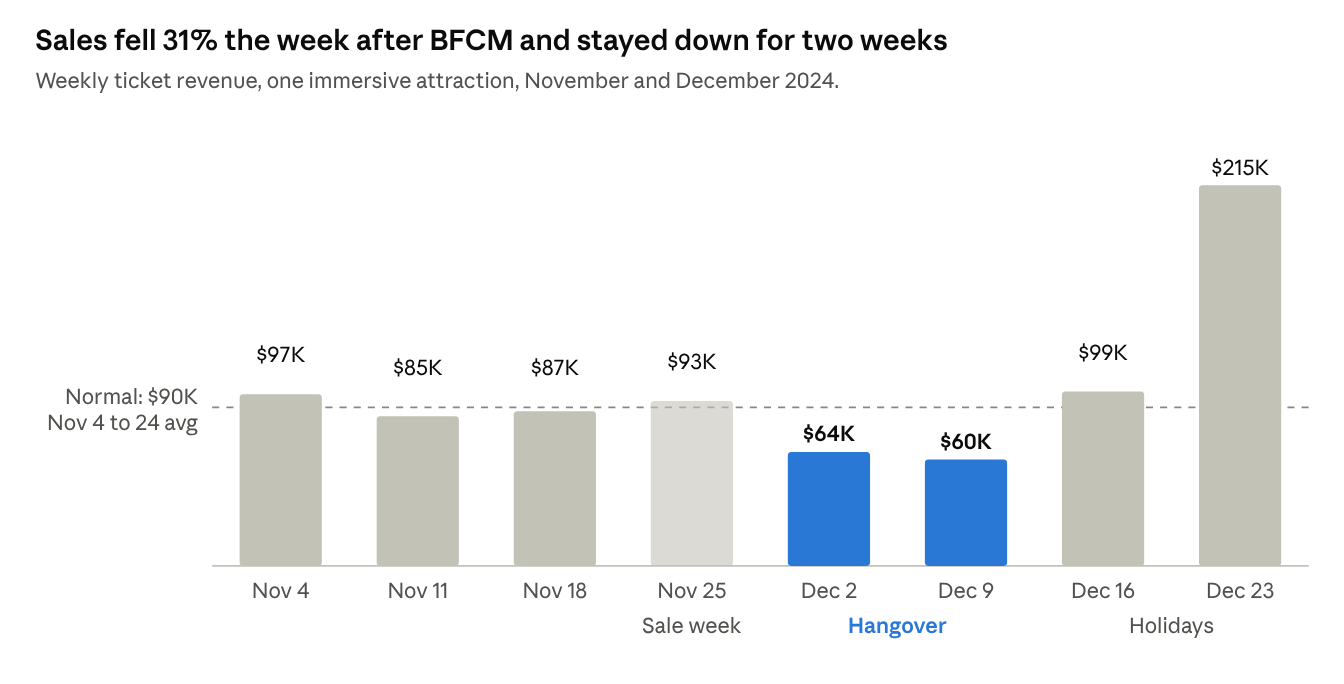
It isn't a one-off. The same venue dropped 34% the week after its 2025 sale. A multi-city game venue we work with fell 26% the week after its 2025 sale, and its second week ran 16% below its pre-sale average.
You can't avoid the hangover, but you can soften it:
- Use the extension. Running 24 to 48 hours past Cyber Monday pushes guests into the first slow weekend, right where the hangover starts.
- Ease off paid for two weeks. Pull ad spend back while demand is soft, then ramp it up again for the last two weeks of December, when volume roughly doubles.
- Don't discount again. A second sale trains guests to wait. Give them a reason to come that isn't price: a new room, a holiday event, a gift card bonus.
- Lean on gifting. The same game venue's weekly gift card sales tripled in two weeks, from $15K the week after the sale to $46K by mid-December.
- Read the dip right. A slow early December after a strong BFCM is the sale working, not a problem to panic over. Judge the full six weeks, not one week at a time.
Your BFCM checklist
- Set the discount at 15 to 20%, or hold off on discounting altogether
- Put it on your most-bought ticket (season pass, or day and anytime tickets)
- Launch no earlier than the Monday of Thanksgiving week
- Extend 24 to 48 hours past Cyber Monday
- Staff and plan capacity for the weekend and 14 days after purchase, not just the holidays
- Hit your owned list first and hardest
- Plan a December offer that isn't a discount to soften the hangover